




Enema Glossary
ANUS (ANAL MUSCLES) – The external doorway out of the colon. Opening and closing of the anus is controlled by a circular band of muscles, the internal and external sphincter muscles. Feces are moved out of the body through the anus during the act of defecation, which is the main function of the anus.
ASCENDING COLON – The first segment of the colon, continuous with and rising up out of the cecum toward the liver.
BILE – A digestive fluid made from cholesterol, salts, and waste products that is produced in the liver, stored in the gallbladder, and passed through bile ducts when food containing fat enters the small intestine. Fats are a potent carrier of toxins; bile, as it carries fats, is one of the main forms of removing toxins such as plastics, heavy metals, and pesticides from the body.
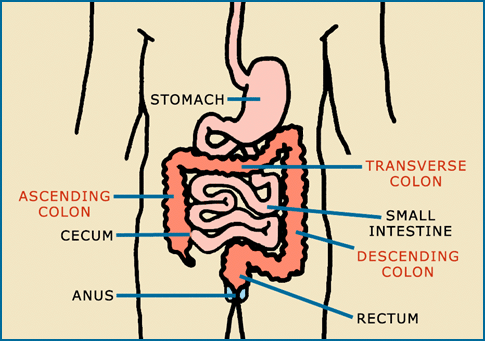
CECUM – The beginning of the colon. A sac where the small intestine dumps into the large intestine.
CLYSTER – An old-fashioned word for an enema.
COLON (LARGE INTESTINE) – A portion of the digestive tract located underneath your ribs and between your hips and shaped roughly like an upside-down “U”. About five feet long in adults, the colon begins where the small intestine leaves off, at the cecum. When you say that your “stomach” hurts, you are often really referring to your colon.
DESCENDING COLON – A segment of the colon between the splenic flexure and the sigmoid, located on the left side of the abdomen.
DUODENUM – The first portion of the small intestine, attached to the stomach.
ELECTROLYTES – Minerals, in fluid, that regulate most metabolic processes in the body, such as the flow of nutrients into the cells and the flow of waste products out of the cells. The main electrolytes (minerals) are calcium, magnesium, potassium, sodium, and bicarbonate. In order to be healthy, our bodily levels of electrolytes must remain within a particular range.
GALLBLADDER – A pear-shaped organ attached to the liver that stores bile.
ILEUM – The lower portion of the small intestine, adjoining the colon.
JEJUNUM – The middle portion of the small intestine, located between the duodenum and ileum.
LARGE INTESTINE (COLON) – The part of the digestive tract, after the small intestine, where the waste products of digestion are accumulated, dehydrated, and prepared for excretion. The water, salts (sodium), and some vitamins of bacterial origin are also absorbed in the large intestine (colon). The end of the colon, or rectum and anus, expels feces.
METABOLIC TYPING – A testing tool to determine an individual eating and supplement program based on the way in which a person processes nutrients into the biochemical tools and structures they need to maintain optimal health.
PERISTALSIS – The involuntary muscular contractions that move material through the entire length of the digestive tract. In a healthy person, colonic peristalsis occurs one to three times per day in order to move the contents of the entire length of the colon into the rectum. Since colonic peristalsis occurs only intermittently, unlike the continuous rhythmic contractions of the small intestine, the colon cleanse can be used safely and with regularity without disrupting a healthy peristaltic rhythm.
RECTUM – A segment of the colon that is continuous with the sigmoid, just in front of and before the anal canal. The rectum usually contains three crosswise and crescent-shaped sections which overlap when the large intestine (colon) is empty. The rectum is approximately 5 inches (13 centimeters) long.
SIGMOID – A naturally twisted segment of the colon that connects the rectum to the descending colon. This area of the colon is rich with portal veins, which carry blood and other substances to the liver. The sigmoid is 16 inches (41 centimeters) long.
SMALL INTESTINE – The part of the digestive tract between the stomach and the colon that acts in both the chemical digestion and absorption of food substances.
THEOPHYLLINE – An alkaloid in coffee that induces the relaxation of smooth muscles, causing blood vessels to dilate. Theophylline is thought to be one of the therapeutic elements of a coffee enema.
TRANVERSE COLON – A segment of the colon that extends from the end of the ascending colon at the hepatic flexure on the right side of the body across the mid-abdomen to the beginning of the descending colon at the splenic flexure on the left side. The transverse colon is approximately 18 inches (45 centimeters) long.