



Enema History
“The Egyptians learned the art,” wrote the Roman historian Pliny the Elder, “from the long-beaked ibis, who washes the inside of its body by introducing water with its beak into the channel by which the residue of our food should leave.”

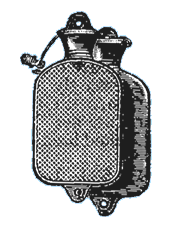
The history of the enema points to key safety issues:
The early enema, or clyster, utilized a metal nozzle. Using a metal nozzle to take an enema always increases one’s chance of perforating the colon. The metal nozzle is no longer in use for taking an enema.
The popular enema used today, the chemical enema, works by drawing water out of the bloodstream and into the colon. The chemical enema is not as safe as the warm water enema. By dehydrating the bowel lining, a chemical enema such as a Fleet® enema can cause a loss of electrolytes.
Mineral oil has traditionally been used as a stool softener in enemas to promote a bowel movement. However, mineral oil is a petroleum product which is toxic to the human body.
Enemas have been used and continue to be used for play and ritual. In these situations, those taking and giving the enema sometimes have poor judgment and lack important procedural information, which decreases the safety of the enema.
Enemas have mostly been administered by emptying out the entire contents of an enema bag into a person’s colon in "one-shot fill" fashion. This can be harmful, painful, and frightening.
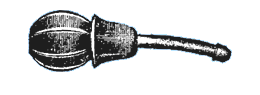
The history of the enema points to a long-used and successful healing tool:
Enemas have been one of the most important tools used in medical hospitals for the care of patients. Although there has been little scientific documentation of enema use in the hospital setting, nurses have observed very few complications.
Enemas have been so vital to quality patient care because medical doctors and nurses know that a patient cannot make solid progress without regular bowel movements. On every patient’s chart is a list of characteristics to manage. On this patient management list is the bowel movement. If a patient doesn’t move the bowels, and is at risk for a bowel obstruction, treatment is administered to empty the bowels. Historically, this colon cleansing treatment was the warm water enema.
Learn more about the history of enema use:
Townsend Letter for Doctors and Patients
Intestinal autointoxication: a medical leitmotif

Learn about enema use and enema mythology in the ancient Mayan culture.
Enemas, taken appropriately, are safe.
To learn more about enemas, please view our instructional DVD, Cleansing, Coffee Enemas & Colon Tubes and our downloadable instructional videos, Large-Volume Enema and Small-Volume Enema. These educational enema videos comprehensively cover important safety concepts regarding in-home enemas. They will inform you on how to perform a therapeutic enema so that you can provide colon cleansing for yourself, in the privacy of your own home, that will have the same therapeutic effects as professional colon hydrotherapy sessions.
For those who wish to look into cleansing the colon using colon hydrotherapy, please view our downloadable instructional video, Cleansing Using Colon Hydrotherapy.